环太平洋
China's earliest tinned iron armor found in Zhejiang: 1,700-year-old anti-rust tech revealed_我的网站

A |
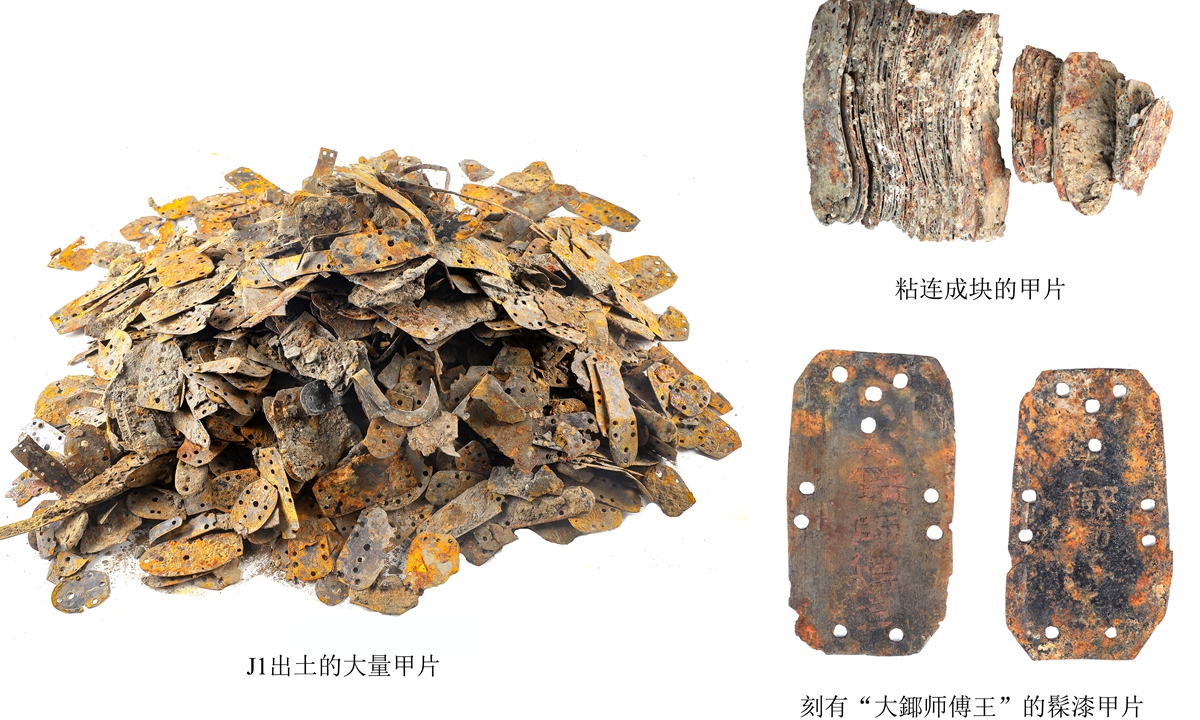
A number of tinned iron armor plates excavated from the Jizhong site Photo: Courtesy of the Shaoxing Institute of Cultural Relics and ArchaeologyArchaeologists at the Jizhong ruins site in Shaoxing, East China's Zhejiang Province, recently unearthed a large number of tinned iron armor plates and semi-finished pieces dating to the Wu period of the Three Kingdoms (222-280), according to the Shaoxing Institute of Cultural Relics and Archaeology. These discoveries represent the earliest known tinned iron artifacts in China to date, as well as the earliest tinned iron production remains found anywhere in the world, proving that an organized, systematic craft industry for tin-plated ironwork existed at that time.
While China has a long history of making tinned bronze and tinware, there has long been a lack of reliable historical records or physical evidence to prove early local production of tinned iron artifacts. The newly discovered armor plates can fill this gap, demonstrating that, by no later than the Wu period, local craftspeople in Zhejiang Province had mastered the art of tin-plating iron surfaces. This reflects the region's advanced metallurgical skills at that time, Ge Shuaikun, a researcher at the Shaoxing Institute of Cultural Relics and Archaeology, told the Global Times on Tuesday.
Over the last three years, archaeologists working at the Jizhong ruins site have excavated hundreds of tinned iron armor plates from ancient wells and ash pits. A preliminary investigation confirmed that the surfaces of these plates contain high levels of tin. Subsequent laboratory analyses were conducted in collaboration with the Shaoxing's institute and the Institute for Cultural Heritage and History of Science & Technology at the University of Science and Technology Beijing with methods such as Scanning Electron Microscopy with Energy Dispersive Spectroscopy (SEM-EDS), X-ray Diffraction (XRD), and Micro-CT to deeply examine the samples' materials, structures, and technological traces.
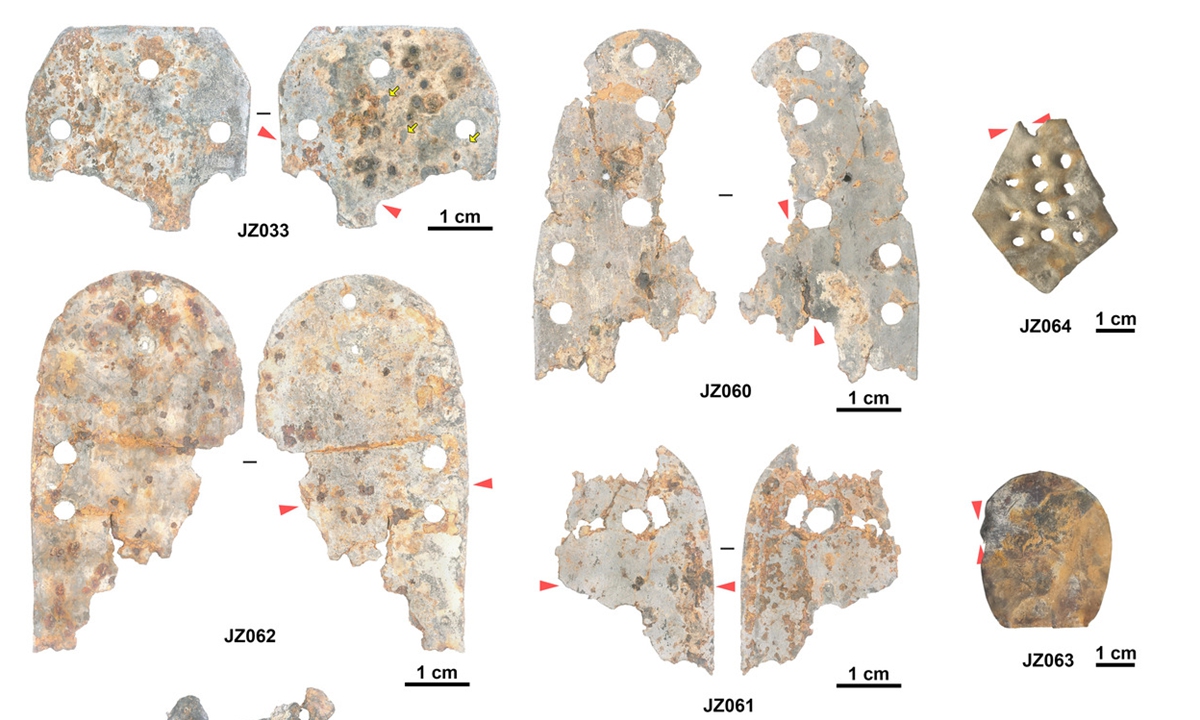
Photo: Courtesy of the Shaoxing Institute of Cultural Relics and ArchaeologyAccording to Ge, tin is a non-toxic metal with a low melting point, excellent corrosion resistance, and a silvery sheen. Tin plating effectively prevents rust, making iron armor far more durable and indeed, even after being buried for 1,700 years, many of these tinned plates retain their silvery metallic shine.
Research shows that the craftspeople immersed iron armor plates in molten tin, thus ensuring complete coverage of the surface with a continuous tinned layer. This coating isolated the iron from exposure to air and moisture, dramatically boosting corrosion resistance. Many of the excavated tinned armor pieces still show a clear, bright silver-white finish.
One major reason for tin-plating the armor was to prevent rust. At the same time, the silvery white shine of tinned iron offered a more striking, beautiful appearance, standing out from the typical dark iron armor of the era. This visual distinction may have marked these pieces as a higher-grade military asset, according to an article from the University of Science and Technology Beijing's official website.
The article said that in earlier eras, from the pre-Qin to Han dynasties, tin was widely used as a surface coating on bronzeware and ceramics. Researchers believe the tin-plating of iron armor discovered at the Jizhong ruins site during the Wu period of Three Kingdoms built upon this local tin-coating tradition, representing an adaptation of those techniques across different materials. The process likely benefited from technological exchange among various specialized workshops at the site, including those making bronze castings, iron weapons, and other metallurgical products.
。 A US civilian airliner had a relatively close encounter with what appeared to be some sort of flying pulsing lights in the sky over North Carolina.,Details of the encounter, which took place on August 12, were shared online by prolific blogger Scott C. Waring, who immediately branded it a UFO sighting.,In the eyewitness account featured on Waring’s blog, the anonymous pilot – the only details he provided about himself were his occupation as “an airline pilot with a major airline in the United States” and his past experience as a military pilot – said the encounter occurred as the plane was flying approximately over the city of Wilmington, while en route from St. Thomas in the US Virgin Islands to Dulles Airport in Virginia.,“At roughly 0055 ET I began seeing slow pulses of light in the sky directly in front of us (to our north). The pulses would last usually 8-10 seconds each and had gaps of darkness lasting anywhere from 10 seconds to over a minute,” the eyewitness account states. “They were slowly moving from left to right. The pulses would be gradual (start very dim and grow into a bright light about the brightness of Venus, and then fade away).”,The plane’s captain also noticed the light and he and the pilot engaged in a discussion about what they were looking at. The pilot also started filming and taking pictures at that point, with the video he recorded from the plane’s cockpit being featured in Waring’s blog post.,“We began seeing 2 lights at a time, often at different altitudes, but always moving generally from left to right when the pulse was at its peak. At one point we watched 2 lights flying in ‘formation,’ almost side by side,” the pilot recalled.,“For a brief time we saw 3 objects at one time. At no point did we see a strobe light or navigation lights on the objects,” he added. “The best way to describe what we saw is 2-3 aircraft circling in left hand turns with their landing lights on, which means that they were only clearly visible when the lights were facing towards us.”,While it wasn’t immediately clear what exactly the lights were, the pilot argued that they were not civilian aircraft, since few of those “can fly above 41,000 feet, and the objects were about 10 degrees above the horizon from our perspective.”,“I was not able to tell the distance of the object from our aircraft, but in the 35+ minutes we watched, they never seemed to get any closer even though we covered about 250 nautical miles in that time. For this reason I believe they were in either the upper atmosphere or in space,” the pilot explained.,He also argued that the lights did not look like a Starlink satellite “train,” and that they definitely were not military aircraft or flares.,Waring, however, exhibited little doubt about what the pilot saw, describing the video recorded by the latter as “amazing and rare footage of a real UFO.”,“This is 100 percent undeniable proof that UFOs are following jets and curious about those aboard them,” the blogger declared.。

B |
Current article:http://3eg.cousizhegaobaolengkuo.bond/list_njrqb/a2g448.html
Published on:22:33:10
