

个人简介
生死狙击


推荐博文
朝5晚9
2026-08-26
分类: 星际迷航2
朝5晚9
German exports to China fall over 12% in H1 as industrial upgrading reshapes trade structure; cooperation remains vital: expert_我的网站

一 |
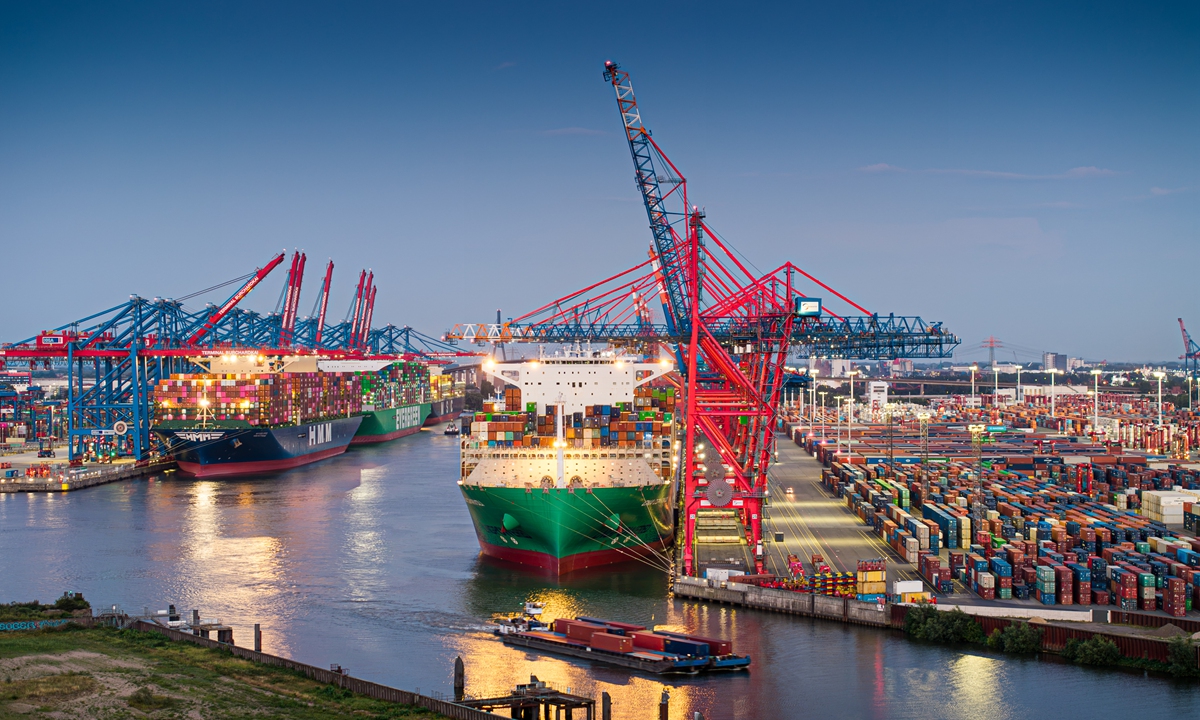
German exports to China fell year-on-year in the first half of 2026, pointing to a deeper restructuring of bilateral trade as China moves up the manufacturing value chain, Chinese analysts said. They also cautioned that the decline should not be read as diminishing China's importance to German businesses, given the deep economic ties and the continued benefits of cooperation for both sides.
Germany's first-half exports to China fell by more than 12 percent year-on-year to just under 37 billion euros ($43 billion), while imports from China rose 8.9 percent to 91.8 billion euros, according to data from Germany Trade & Invest (GTAI) cited by Reuters on Sunday. Germany's trade deficit with China widened to about 55 billion euros from 40 billion euros a year earlier, the report said.
Reuters cited Corinne Abele, GTAI's East Asia expert, as pointing to weaker domestic demand and the fact that German companies are increasingly producing inside China.
Commerzbank economist Vincent Stamer said that China's diminishing reliance on Germany showed that the country is becoming more independent of Western powers and catching up technologically, according to Reuters.
China has continued to strengthen its capabilities in sectors including new-energy vehicles, artificial intelligence and advanced manufacturing, enabling more products and technologies that previously depended on imports to be supplied domestically, Zhao Junjie, a senior research fellow at the Institute of European Studies at the Chinese Academy of Social Sciences, told the Global Times on Sunday.
"This means the structure of China-Germany trade is changing," Zhao said, noting that as Chinese industries move up the value chain, China's reliance on some German industrial products is declining, while Chinese companies are becoming more competitive in sectors where German manufacturers traditionally enjoyed strong advantages.
In a position paper released on July 28, China's Ministry of Commerce (MOFCOM) said that the rapid growth of China's modern industries is driven by innovation, with nationwide research and development (R&D) spending growing by an average of 10 percent annually during the 14th Five-Year Plan (2021-25) period.
The changing trade trend is also linked to Germany's own industrial competitiveness and policy environment, Zhao said, noting that high energy costs, demographic pressures and slower investment in some emerging technologies have weighed on the country's industrial upgrading and innovation.
At the same time, political and security considerations have increasingly shaped Germany's economic policy toward China, as Berlin has moved closer to the broader US and EU "de-risking" agenda, Zhao said.
"Such policies can be a double-edged sword, raising costs for German companies in China and disrupting bilateral economic cooperation while seeking to pressure Chinese industries."
However, it is notable that overall China-Germany trade remained substantial. Total bilateral trade exceeded 128 billion euros in the first half, about 3 billion euros more than Germany's trade with the US, according to Reuters.
China overtook the US as Germany's top trading partner in 2025 after US President Donald Trump launched sweeping protectionist tariffs that weighed on German exports to the US.
Falling German exports should not be seen as diminishing China's importance to German businesses, especially as bilateral ties are increasingly expanding beyond trade into investment, local production and R&D, analysts said.
German companies invested more than 7 billion euros in China in the first 11 months of 2025, up 55.5 percent from 4.5 billion euros in 2024 and 2023 and hitting a four-year high. German companies are bulking up their China business and adopting "China for China" production strategies partly to reduce exposure to possible tariffs and export restrictions, according to Reuters.
Major German companies are also deepening their presence in China. BASF's Verbund site in Zhanjiang, South China's Guangdong Province went fully operational in March with an investment of 8.7 billion euros, the largest single investment project wholly owned by a German enterprise in China, the Xinhua News Agency reported.
"China and Germany have developed deeply intertwined economic interests over many years," Zhao said. Rather than treating stronger Chinese industries as a reason to reduce cooperation, Germany should adapt to a relationship in which competition increasingly coexists with investment, innovation and industrial collaboration, he noted.
Recent high-level exchanges have also underscored the importance both sides attach to economic ties. During a meeting with German Economy Minister Katherina Reiche in May, Chinese Vice Premier He Lifeng said that China and Germany are important economic and trade partners with a solid foundation, enormous potential and strong complementarity, calling on both sides to consolidate cooperation in traditional sectors and tap opportunities in emerging fields, according to the Xinhua News Agency.
Reiche said that the German business community remained confident about China's economic prospects and innovation capabilities and would continue to deepen cooperation, Xinhua reported.
The two sides have also moved to strengthen institutional mechanisms. China and Germany agreed to restart the China-Germany Joint Economic Committee and establish two new working groups on trade and investment and industrial cooperation, according to the MOFCOM.
。 Islamabad, Oct 21 (UNI) The Financial Action Task Force (FATF) on Friday removed Pakistan from a list of countries under “increased monitoring”, also known as the “grey list”.
Addressing the press conference at the conclusion of the its plenary, President Raja Kumar noted that Pakistan had been on the grey list since 2018.
“It has two concurrent action plans. After a lot of work by Pakistan authorities, they have largely addressed all of the action plan items,” he said.
He stated that the task force had conducted an onsite visit at the end of August. The onsite team verified that there is a high-level of commitment from the Pakistani leadership, sustainability of reforms and commitment to make improvements in the future, he said.
“As a result of these action plans, Pakistan has made significant improvements to strengthen the effectiveness of this framework for combatting terrorism financing.”
Foreign Minister Bilawal Bhutto-Zardari was quick to congratulate the country on the development moments before the FATF press conference began, according to Dawn reports.
Prime Minister Shehbaz Sharif said Pakistan’s exiting the FATF grey list is a “vindication of our determined and sustained efforts over the years”, according to reports.
He congratulated the civil and military leadership as well as all institutions whose hard work led to today’s success. “Aap sab ko bohat bohat Mubarak,” the premier said, following up with a text smiley.
In a follow-up tweet, PM Shehbaz particularly commended the role and efforts of Foreign Minister Bilawal Bhutto, Army Chief General Qamar Javed Bajwa and their teams and all political parties for putting up a united front to get Pakistan out of the grey list.
Pakistan was included among jurisdictions under increased monitoring list in June 2018 for deficiencies in its legal, financial, regulatory, investigations, prosecution, judicial and non-government sector to fight money laundering and combat terror financing considered serious threat to global financial system.
Islamabad made high-level political commitments to address these deficiencies under a 27-point action plan. But later the number of action points was enhanced to 34.
The country had since been vigorously working with FATF and its affiliates to strengthen its legal and financial systems against money laundering and terror financing to meet international standards in line with 40-recommendations of the FATF.
A 15-member joint delegation of the FATF and its Sydney-based regional affiliate — Asia Pacific Group — paid an onsite visit to Pakistan from Aug 29 to Sept 2 to verify the country’s compliance with the 34-point action plan committed with the FATF.
The authorities that had kept the countrywide visit of the delegation low profile later termed it “a smooth and successful visit”.
The delegation had detailed discussions with relevant agencies pursuant to the authorisation of onsite Visit by FATF Plenary in June 2022.
According to the Foreign Office, the focus of the visit was to validate on ground Pakistan’s high-level commitment and sustainability of reforms in AML/CFT regime and [it] looked forward to logical conclusion to the evaluation process.
Pakistan believed that as a result of strenuous and consistent efforts over the past four years, it has not only achieved a high degree of technical compliance with FATF standards but also ensured high level of effectiveness through implementation of two comprehensive FATF action plans.
In June this year, FATF had found Pakistan “compliant or largely compliant” on all the 34 points and had decided to field an onsite mission to verify it on ground before formally announcing the country’s exit from the grey list that finally took place in August and September.
In terms of technical compliance with FATF standards, Pakistan has been rated by APG as “compliant or largely compliant” in 38 out of 40 FATF recommendations in August this year, which placed the country among the top compliant countries in the world.
UNI GNK。
Current article:http://3eg.cousizhegaobaolengkuo.bond/mnseis/20260826/4428.html
Published on:01:59:32
相关热门文章
- Malayalam Actor-Director EA Rajendran Passes Away at 71
- 机构:存储短缺导致平板显示器市场下滑
- 探访小鹏汇天飞行汽车量产工厂(组图)
- 机械师新款曙光S台式机首发6999元:酷睿7 230H+RTX5060
- 画面曝光!外媒:以定居者残忍殴打一老人,后者曾遭枪击失去一条腿
- 动漫市场复苏:优酷、爱奇艺、腾讯如何互相挤压
- Tight hug after 27 years: Reunion across ocean, marking China-US folk friendship
- 区政府党组(扩大)会议召开
- Stability AI 完成 7600 万美元 B 轮融资:EA 与三大音乐娱乐企业均参投
- 俄罗斯遭导弹袭击!已致15人死亡
- Sreeleela Joins Choomantar Cast Along With Abhay Verma
- 超100款新车砸向市场!现代汽车公布史上最大产品投放计划
- 好久没动的股票账户显示休眠了,里面还有点钱,怎么激活恢复正常交易?必须去营...
- 新时代文明实践 | 钱清街道开展“与梦想童行”中国梦想日主题活动
- 【先驱自媒】震惊!新西兰国会议员被指控在奥克兰精品店行窃!已被免职!新西兰荣登著名旅游排行榜;2023年最受欢迎的婴儿名字揭晓…


